> For the complete documentation index, see [llms.txt](https://doc.anytype.io/anytype-docs/llms.txt). Markdown versions of documentation pages are available by appending `.md` to page URLs; this page is available as [Markdown](https://doc.anytype.io/anytype-docs/espanol/nociones-basicas/relations.md).
# Relaciones
### Comprender las relaciones
Las relaciones son la clave para organizar y conectar tus objetos y tu conocimiento en Anytype. Las relaciones desempeñan dos funciones en Anytype:
* **Definen atributos**. Puedes usar las relaciones para asignar características a un objeto.
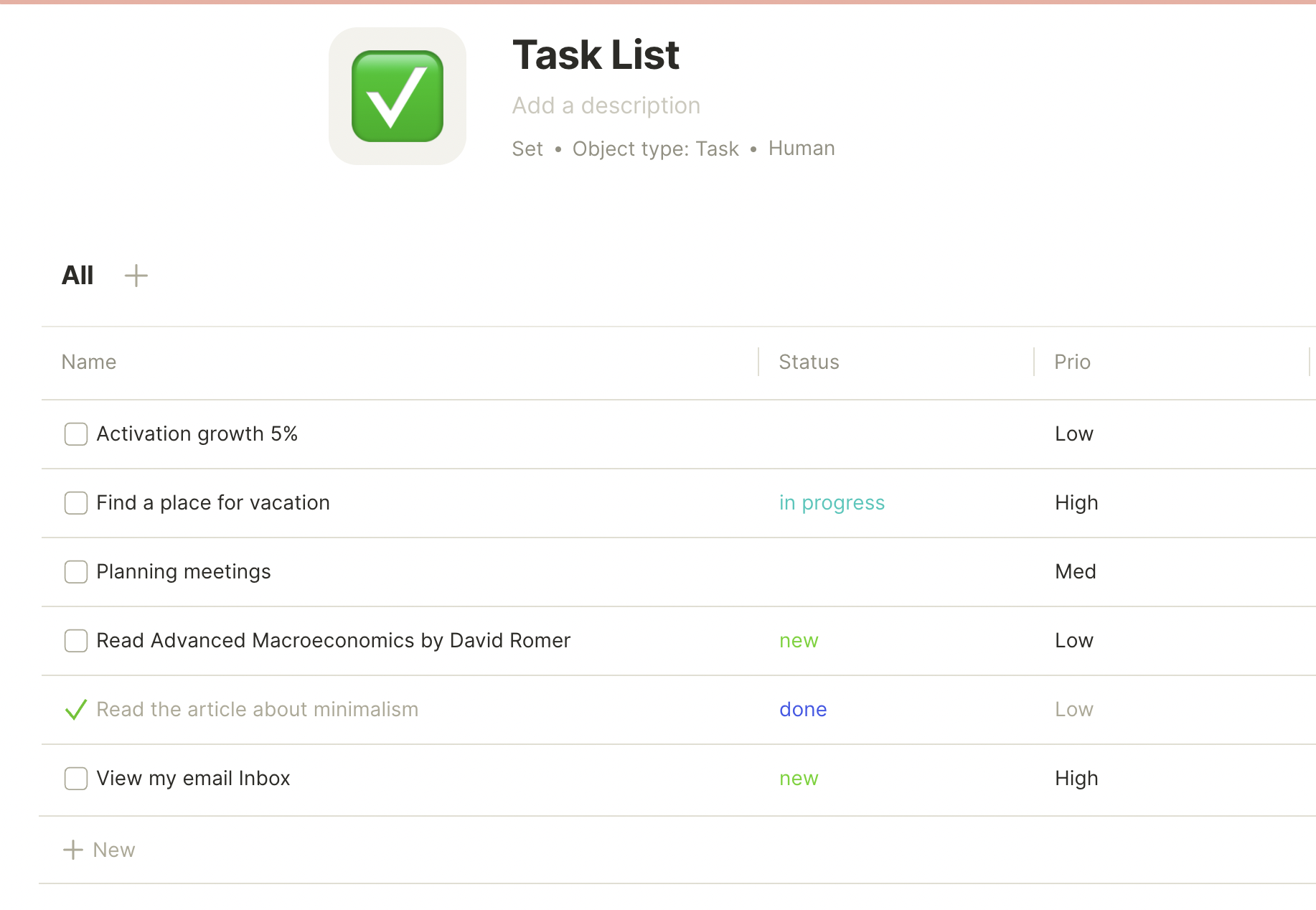
* Por ejemplo, al crear una tarea en Anytype, puedes añadir relaciones como *Estado*: Hecho/Pendiente, o *Prioridad*: Baja, Media o Alta.
* Si lo imaginamos como una base de datos, las relaciones serían los encabezados de columna de cada fila, con el objeto en la columna A.
* Una vez configurados los atributos, es posible ordenar y filtrar los objetos según las relaciones que hayas definido en la vista del conjunto.
* **Definen conexiones**. Las relaciones pueden servir también para vincular un objeto con otro.
* Volviendo al ejemplo de la tarea, puedes añadir la relación *Persona asignada* y asignarle a esa tarea a otro objeto de tu espacio.
* Igual que antes, puedes ver las personas asignadas como relaciones en la vista del conjunto o en el gráfico.
---
# Agent Instructions
This documentation is published with GitBook. GitBook is the documentation platform designed so that both humans and AI agents can read, navigate, and reason over technical content effectively. Learn more at gitbook.com.
## Querying This Documentation
If you need additional information that is not directly available in this page, you can query the documentation dynamically by asking a question.
Perform an HTTP GET request on the current page URL with the `ask` query parameter, and the optional `goal` query parameter:
```
GET https://doc.anytype.io/anytype-docs/espanol/nociones-basicas/relations.md?ask=&goal=
```
`ask` is the immediate question: it should be specific, self-contained, and written in natural language.
`goal` is optional and describes the broader end goal you are ultimately trying to accomplish on behalf of the user. GitBook uses it to tailor the answer towards what is most useful for that goal.
The response will contain a direct answer to the question and relevant excerpts and sources from the documentation.
Use this mechanism when the answer is not explicitly present in the current page, you need clarification or additional context, or you want to retrieve related documentation sections.