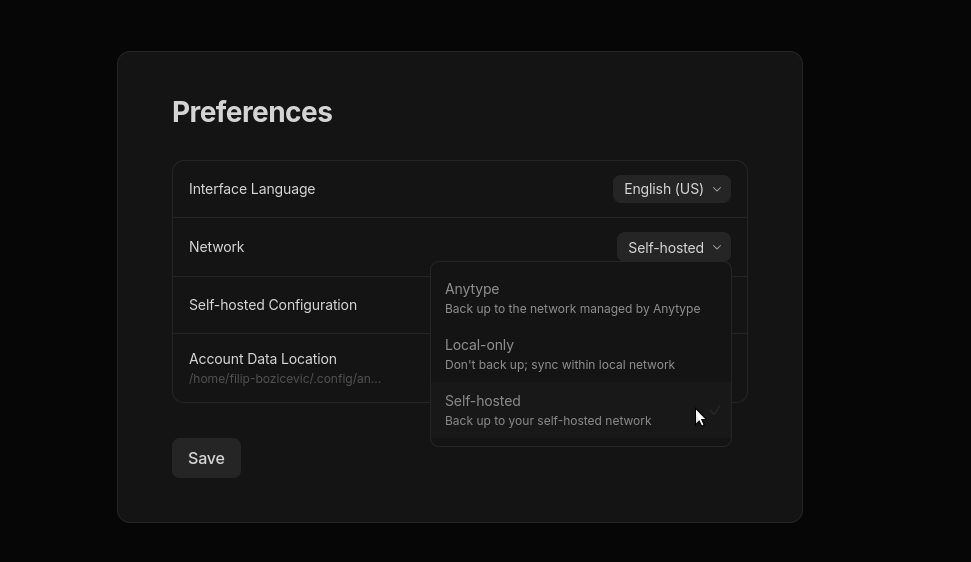
> For the complete documentation index, see [llms.txt](https://doc.anytype.io/anytype/llms.txt). Markdown versions of documentation pages are available by appending `.md` to page URLs; this page is available as [Markdown](https://doc.anytype.io/anytype/russian/dannye-i-bezopasnost/self-hosting/self-hosted.md).
# Самостоятельный хостинг
Чтобы создать резервные копии ваших пространств и данных в сети с самостоятельным хостингом, вам необходимо настроить конфигурацию сети. Если вы еще не управляете своей собственной сетью, ознакомьтесь с этим [руководством](https://tech.anytype.io/how-to/self-hosting). Также существует [образ docker](https://github.com/anyproto/any-sync-dockercompose), который поддерживается командой.
### Как переключиться на сеть с самостоятельным хостингом
Мы настоятельно рекомендуем использовать отдельные учетные записи для каждой сети. Если у вас уже есть учетная запись в сети Anytype и вы хотите переключиться на сеть с самостоятельным хостингом, экспортируйте все ваши пространства и импортируйте их в новую учетную запись после переключения режима сети.
Обратите внимание, что все ваши устройства должны быть вручную переключены на ту же самую сеть с самостоятельным хостингом.
#### Настольный компьютер
1. Выйдите из текущей учетной записи.
2. На экране приветствия нажмите на иконку шестеренки в правом верхнем углу.
3. В поле “Сеть” выберите опцию “Самостоятельный хостинг”.
4. Загрузите конфигурацию вашей сети с самостоятельным хостингом (файл \*.yml) в соответствующее поле.
5. Нажмите кнопку “Сохранить”.
6. Создайте новую учетную запись или войдите в существующую.
#### Мобильное устройство
1. Выйдите из текущей учетной записи.
2. На экране приветствия нажмите на иконку шестеренки в правом верхнем углу.
3. Нажмите на “Самостоятельный хостинг” в подменю “Сети”.
4. Нажмите на “Нажмите, чтобы предоставить конфигурацию сети”, чтобы загрузить конфигурацию вашей сети с самостоятельным хостингом (файл \*.yml).
5. Создайте новую учетную запись или войдите в существующую.
---
# Agent Instructions
This documentation is published with GitBook. GitBook is the documentation platform designed so that both humans and AI agents can read, navigate, and reason over technical content effectively. Learn more at gitbook.com.
## Querying This Documentation
If you need additional information that is not directly available in this page, you can query the documentation by asking a question.
Perform an HTTP GET request on the following URL with the `ask` and `goal` query parameters:
```
GET https://doc.anytype.io/anytype/russian/dannye-i-bezopasnost/self-hosting/self-hosted.md?ask=&goal=
```
`ask` is the immediate question: it should be specific, self-contained, and written in natural language.
`goal` is what the user is ultimately trying to achieve, the reason they need the answer. Sharing it helps GitBook give you a better, more relevant answer. A goal is most helpful when it describes the outcome the user wants rather than restating the question. For example, with `ask=how do I create an API token`, a goal like `automate deployments from our CI pipeline` lets GitBook tailor the answer to that use case.
The response will contain a direct answer to the question and relevant excerpts and sources from the documentation.
Use this mechanism when the answer is not explicitly present in the current page, you need clarification or additional context, or you want to retrieve related documentation sections.