> For the complete documentation index, see [llms.txt](https://doc.anytype.io/anytype/llms.txt). Markdown versions of documentation pages are available by appending `.md` to page URLs; this page is available as [Markdown](https://doc.anytype.io/anytype/features/graph.md).
# Graph
Visualize the connections between your Objects.
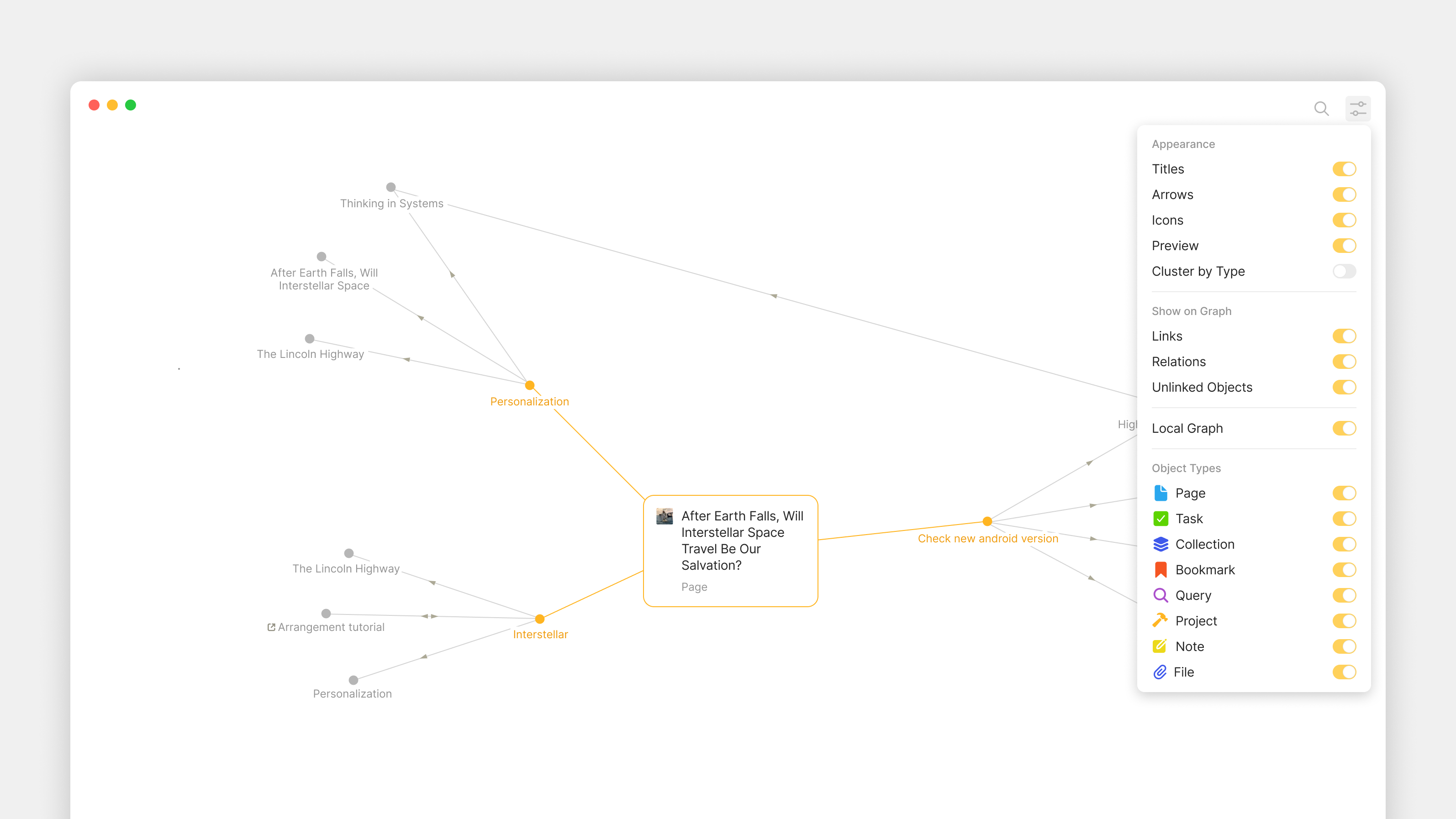
The **Graph** is a live, visual map of every Object in your Channel and how they connect to each other. Each Object is a node; each link or Property reference is an edge. Open the Graph and you see your Channel's structure — what's central, what's isolated, what clusters around which projects.
## Opening the Graph
The Graph icon (a small node-and-edge symbol) appears at the top of every Object. Click it to switch to Graph view.
You can also press the keyboard shortcut listed in your shortcut settings to open Graph from any Object.
## Reading the Graph
Each **node** is an Object. Hover over a node to see its title and Type.
Each **edge** (line connecting two nodes) represents a relationship — either a link in the editor, an Object Property pointing to another Object, or a backlink.
The **direction of the edge** (when arrows are enabled) shows which Object references which:
* A → B means Object A links to or references Object B
* A bidirectional connection (A ↔ B) means both link to each other
## Display settings
Click the gear icon (or settings menu) on the top right of the Graph view to access display options:
#### Appearance
* **Show titles** — display Object names next to each node (toggle off for a cleaner view)
* **Show arrows** — show edge direction
* **Show icons** — display Object icons at each node
#### Connections
* **Show links** — show editor links between Objects
* **Show Properties** — show Object Property relationships
* **Show Unlinked** — show Objects with no connections (Orphans)
Each toggle changes the Graph in real time. You can build a focused view (e.g., "show only Property connections, hide editor links") to study one type of relationship at a time.
#### Filtering by Type
The **Filter by Types** menu lets you show only certain Object Types in the Graph:
1. Click the filter icon.
2. Toggle Types on or off.
This is the fastest way to study a slice — for example, "show only Tasks and Projects" to see how your work breaks down.
## Search in the Graph
The search at the top of the Graph lets you find specific Objects:
* Type any portion of an Object's title to highlight matching nodes
* Press Enter to navigate to the first match
* Use arrow keys to cycle through matches
Matched nodes are highlighted; the rest of the Graph dims so you can see them at a glance.
---
# Agent Instructions
This documentation is published with GitBook. GitBook is the documentation platform designed so that both humans and AI agents can read, navigate, and reason over technical content effectively. Learn more at gitbook.com.
## Querying This Documentation
If you need additional information that is not directly available in this page, you can query the documentation by asking a question.
Perform an HTTP GET request on the following URL with the `ask` and `goal` query parameters:
```
GET https://doc.anytype.io/anytype/features/graph.md?ask=&goal=
```
`ask` is the immediate question: it should be specific, self-contained, and written in natural language.
`goal` is what the user is ultimately trying to achieve, the reason they need the answer. Sharing it helps GitBook give you a better, more relevant answer. A goal is most helpful when it describes the outcome the user wants rather than restating the question. For example, with `ask=how do I create an API token`, a goal like `automate deployments from our CI pipeline` lets GitBook tailor the answer to that use case.
The response will contain a direct answer to the question and relevant excerpts and sources from the documentation.
Use this mechanism when the answer is not explicitly present in the current page, you need clarification or additional context, or you want to retrieve related documentation sections.